Thursday, September 21, 2017

Florence: City of Art

The purpose of art is washing the dust of daily life off our souls.
Pablo Picasso, Spanish artist (1882-1973)

I am a day behind in posting thanks to a limoncello at dinner last night that put me in the mood for sleep rather than blog posting. My soul was satiated by the art of the day, with the delicacies of Giotto, Botticelli, Raphael, Caravaggio, Michelangelo and Da Vinci, followed by the culinary delights at Nella's.

After six years of conservation work, Leonardo's The Adoration of the Magi has recently returned on display at the Uffizi Gallery. Leonardo left the altarpiece unfinished because he left Florence to work for the dukes in Milan. It's unfinished nature makes me feel a closer link to the artist. Amazing.

In the afternoon we grabbed a train from Florence's Santa Maria Nouvella station and headed to Pisa.

The best lawn in all of Italy carpets Pisa's Plaza of Miracles with the baptistery, basilica and (learning) bell tower. The lovely filigree architecture is all Pisan.

The basilica's interior is awesome.

Galileo is said to have developed his ideas about pendulums as a teenager sitting in the basilica watching this lamp swing in the breeze. (The sermon obviously didn't hold his attention.)


I was bad. I indulged in two cones today. We had one in Pisa but I couldn't resist a second from a shop that we passed on our walk from the Florance train station back to our hotel. Nut butter was topped with caramel.

Finding the hotel's little terrace, we toasted the day within sight of the Arno River.

We made a return visit to Trattoria Nella for dinner because it was so good last night.

We were very fond of the house red wine served in heavy ceramic jugs.

Strangely, there was a contemporary art installation in our old neighbourhood. Entitled "Freedom", it was composed of numerous Vespa bodies running up the wall of a multi-storey hotel accompanied by this Vespa on groundlevel. I would like to tootle around town on this one.

The day ended with a walk over the Ponte Vecchio on which a musician set himself up and was singing (pretty well) Leonard Cohen's "Hallelujah" as we passed. A very special day.

As I am having internet challenges in our Venice hotel, the next installation will come some unknown future time. Stay tuned.

Tuesday, September 19, 2017

An Intoxicating City

Everything about Florence seems to be coloured with a mild violet, like diluted wine.
Henry James, American author (1843-1916)

Following a fairly smooth two-hour drive, with only a small detour because I feared we had wandered into one of the city's heavily-fined resident-only ZTL zones, we arrived in Florence, that great birthplace of the Renaissance.

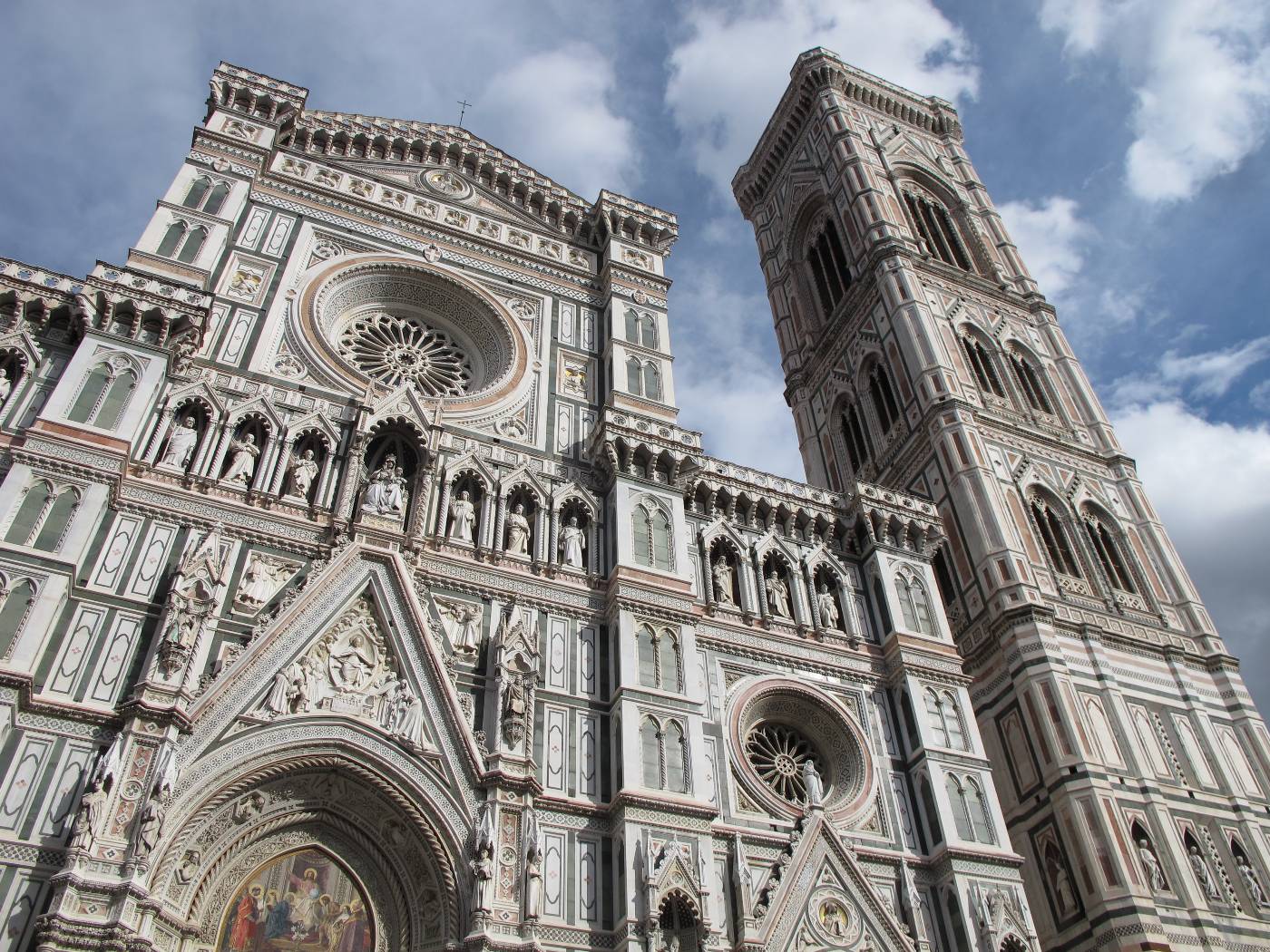
Known for Brunelleschi's daring dome on the Duomo . . .

and Giotto's belltower . . .

and the Accademia Gallery with Michelanglo's unfinished Prisoners and the perfection of David created when he was only 26 years old,

and which that great critic of Renaissance art, Giogio Vasari, wrote, "there has never been seen a pose so fluent, or a gracefulness equal to this, or feet, hands and head so well related to each other with quality, skill and design."

Michelangelo brings to life in stone human ability and confidence to accomplish greatness when infused by divine will.

That gracefulness, quality, skill and design are also evident in the Ferrari that Bro took for a spin this afternoon. It's a thrill to be immersed in such beauty.

Our day concluded with a traditional meal at Trattoria Nella, located around the corner from our hotel. The weather has turned chilly so I opted for ribollita soup that is thickened with day-old bread.  I kept repeating myself saying how delicious it was. The house Chianti poured from a heavy ceramic jug was also delicious. I followed with rabbit and ended by dipping Cantucci biscuits in vin santo. Bro made sure that I made it back to the hotel. Did I mention that it was around the corner. :-)

A presto!


Monday, September 18, 2017

Living like a Count

 We have enjoyed lovely hotels on our visit, beginning in Rome and then in Sorrento. Buoninsegna in the Tuscan hills to the east of Siena is blissful. Bro and SIL have the room with the two windows in the top right. It is called the Limonaia, after the lemons that grow on the property. We are also surrounded by pomegrantes, apples, olives and grapes. This setting has to be good for our health!

Every time we arrive at the entry portal I feel a sense of relief that we have arrived at our home away from home.

Two elegant flights of stairs lead to the main floor with the bedrooms.

The view from the upper portico is breathtaking.

The Villa Buoninsegna was built in the second half of the seventeenth century by Count Pietro Buoninsegni, who is said to have left his ancestral home in Poggio Santa Cecilia over a love quarrel. When the quarrel was patched up, he returned home, leaving the Villa Buoninsegna to be inhabited by a series of tenant farmers, or mezzadri, who managed the estate and split its production. The farm registers listing agricultural products handed paid to the manager are still held by the current owners.

After World War II, Italy's mezzadria system was dismantled and farmers moved to the cities to work in factories.Count Duccio Buoninsegni sold the ancestral home in the 1970s and restored Villa Buoninsegna, furnishing it with fine furniture and paintings. New owners fully restored the Villa in 2003, preserving the original structure while converting it to a guest residence.

This afternoon, we all enjoyed sitting at the dining room on the second floor to connect with family and friends via our computers.

The main floor breakfast room is also very peaceful.

And the breakfast is bountiful with top quality local products. Even the apple juice is artisanal.

I love the colours of the vines that are growing on the villa's walls. Fall is here.

 Sadly, tonight is our last night in this lovely oasis. It has made such good memories.

The Aged Beauty of Siena

Anni e bicchieri di vino non si contano.
Age and glasses of wine should never be counted.
(Enjoy life. Forget about your age.)
Italian adage

We organized a walking tour of Siena through Context Tours. We met our guide Stella in Mother Teresa Square and began the tour there at the spacious church of San Domenico. It's most significant feature is the chapel dedicated to St. Catherine of Siena, located on the far right of the photo. This medieval woman, who couldn't read or write, had an exceptional mind. She helped the sick during the Black Death and later travelled to Avignon and convinced the Pope to return to Rome, thus ending the schism in the Roman church. She is the patron saint of Italy and Europe  . . . and of nurses -- so I lit two candles before her image with prayers for improved health.

Stella treated our little group of five to a visit of the State Archives. Now that may seem boring to some people, but here are records of people known by Dante and who figure in his masterpiece poem, The Inferno. We were shown one record of a fine paid by Dante and his friend because they were found out on the streets after curfew after carousing.

This lovely image decorated the cover of the ledger that recorded taxes paid for luxury goods.

This is a letter sent by the Holy Roman Emperor to Siena and bears his very thick wax seal. Seeing items like these that bring to life the history here blows my mind.

From the Archives we visited the city's ancient synagogue and then entered the famous Il Campo, the city's main piazza where the Palio horse race is held. Our guide gave us the local viewpoint and was able to explain the excitement and importance of the competition between Siena's districts.

Each district has a flag and an emblem that decorate and delineate their boundaries, like this goose lamppost. Our guide is from the Tower district and had few good words about the geese, who apparently are rather pompous.
When we started our walk at 10 in the morning we had this view of the Duomo. It captured the expansiveness of the building but it did not reveal anything of its incredible beauty.

Three hours later we stood before its western entrance. Dedicated to the Assumption of Mary, this medieval church bears the black and white architecture that the great trading cities of Italian adopted from the east.

After working up an appetite with all the walking, we were pointed to this sandwich shop and enjoyed a lunch break with an incredible view for just a few euros.

We concluded our day with a visit to a wine shop where the proprietor discovered an Etruscan tomb when laying a new floor in his backroom. While working to remove the old flooring, the whole thing caved in and the tomb was revealed. It had been known in the 13th century because there were supporting arches of that date for the building above and fine, like new stairs going down. The shop focuses on Brunellos so I bought what I am told is a good 'rosso' table wine from Montalcino that is quite drinkable (according to the proprietor, who tried not to look at me with pity when I said that I didn't fancy Brunello).

A presto!

Update:

This evening we ventured out in the rain for dinner in the old medieval city of Rapolano Terme, the town nearest our B&B.

The glassware and tablesettings at Il Granaio were exquisite, as was the mixed antipasto, the duck, and the codfish ravioli. On the recommendation of the server, we thoroughly enjoyed the reserve Chianti from Podere Alberese.

I swooned at the lusciousness of the ricotta mousse with sour cherry topping. I will have sweet dreams tonight! (Is it just me, or is that mousse smiling?)

Buonanotte. Good night. Sleep well.


Sunday, September 17, 2017

A Day of Good Health

Buon vino fa buon sangue.
Literally: Good wine makes good blood.
Figuratively: A glass of wine a day keeps the doctor away.
Italian adage

We headed south from our B&B to the Tuscan wine capitals of Montepulicano and Montalcino and the beautiful Val d'Orchia. Bro didn't mind sharing the road with the numerous cyclists out for a strenuous Sunday spin.

After parking the car half way up the mount of Montepulicano, our climb brought us to the Jesuit Church of Gesu where I lit a candle for Ruth, a friend with whom I have enjoyed many a concert and who passed away while we have been on our journey.

Reaching the top of the mount, in the Piazza Grande, we tasted the best of the Contucci family's Vino Nobile at its shop. We came away with a couple of bottles.

Then we descended into the stunning wine cellar of the Palazzo Ricci. It is appropriately named the Wine Cathedral. While the palace above dates to the 15th century, the cellars have sections dating to the 14th century and even earlier as there are remains of Etruscan tombs dating to the seventh century BC.

While sampling the noble wine of Montepulciano, the ruby red colour of the wine reflected the traditional costume of a troop representing one of the town's quarters. We had caught the end of marching of colours as the group returned home.

Leaving Montepulciano, we drove country roads, including across 10kms of gravel, westwards across the Tuscan countryside. We delighted in the lines of cypress trees. Across from La Foca estate, we stopped at the Dopolavoro ("After Work") cafe for a first-rate sandwich in the back garden.

Inside Montalcino's 14th century fortress, we sampled a flight of five of the best Brunellos made by some of the 249 smaller wineries that encircle the town. The mammoth winery of the area is Banfi, which produces much of the Brunello sold worldwide. We came away in agreement that we prefer the less tannic nobile.

Our final stop of the day was the Benedictine Abbey of Monte Oliveto Maggiore. My research had indicated that the monks performed their final mass with Gregorian chant. We arrived just as the bells chimed, calling the faithful to prayer. We found that the mass was being read in Italian so we took the opportunity to visit the frescoes in the cloister that present the life of the abbey's founder, Bernardo Tolomei. In a series of paintings encircling the cloister, Renaissance painters Luca Signorelli and il Sodoma visually presented three-dimensional stories on flat walls. I particularly liked this one with the detail of the cat challenging the dog over a table scrap.

We took a peek into the Abbey's refectory that was laid out for the monks dinner. The scent of fresh warm bread was enticing.

And so we took an early dinner ourselves at the Abbey's restaurant, located within its guard tower. It is operated by a very friendly family. Our starter of a mix of Tuscan appetizers was as delicious as it was beautiful. We paired it with the white wine produced at the monastery.

We returned to our B&B well content. Now it is time for sleep.

A presto!